When Does Benchmarking Become Misleading ?
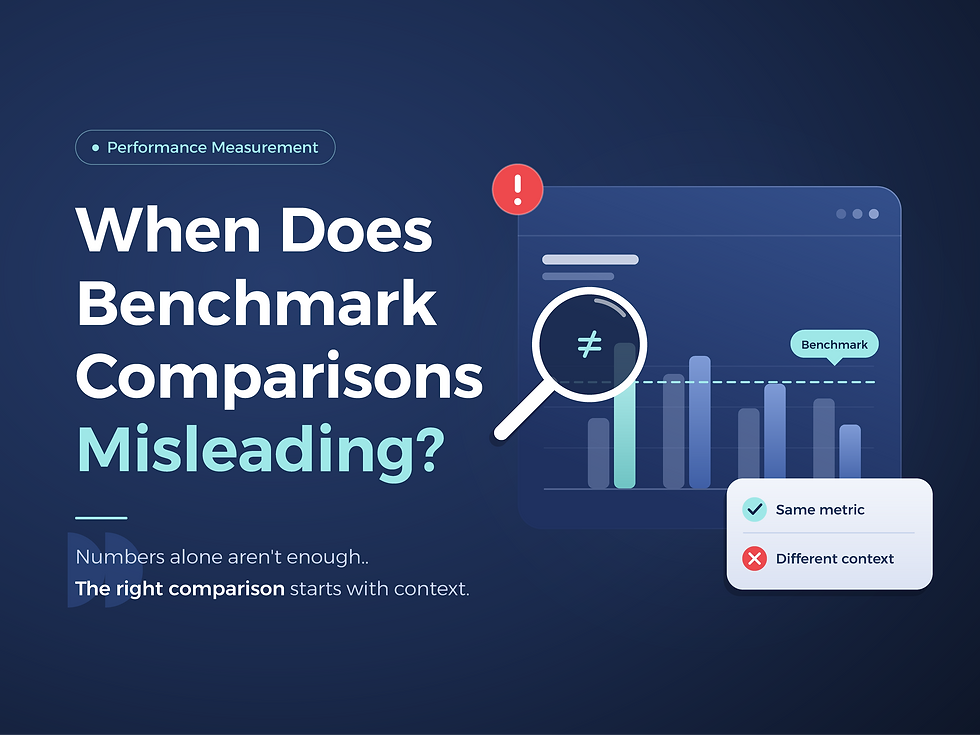
Benchmarking is one of the most widely used tools in market research and competitive analysis. It allows us to compare a company’s performance with that of its competitors, one industry with another, one city with another, or one economy with another, helping us understand where we stand and identify performance gaps and opportunities.
However, the problem does not always lie in the accuracy of the numbers. Sometimes, all the figures are correct, the sources are reliable, and the calculations are sound, yet the conclusions remain misleading. This happens when the entities being compared are not genuinely comparable in the first place.
For this reason, the quality of benchmarking should be assessed against three key pillars:
1. Context
A number cannot be separated from the environment in which it was generated.
When comparing the growth of an industry across two countries, for example, it is essential to consider the size of each economy, population, income levels, regulatory frameworks, market maturity, economic cycles, and even the time period being examined.
An emerging market may grow by 15% annually, while a mature market grows by only 5%. Looking at these figures in isolation may suggest that the first market is performing better. However, the second market may be significantly larger, more profitable, and more stable.
The key question is not: Who achieved the higher figure? It is: In what context was that figure achieved?
2. Comparability
The less comparable two entities are, the less meaningful the benchmarking results become.
Comparing a three-year-old startup with a company that has been operating for thirty years may be useful for certain performance indicators, but inappropriate for others. The same applies when comparing Riyadh with a smaller city, a bank with a fintech company, or the Saudi market with a global market that differs significantly in its structure.
This is why the peer group must be defined before the analysis begins, based on variables such as company size, business model, industry, maturity stage, and customer segment.
Establishing comparability is not a minor technical step. It may be the most important decision in the entire benchmarking process.
3. Data Reliability and Consistency
Having a reliable source does not necessarily mean the data is comparable.
Two countries may publish official statistics on small and medium-sized enterprises (SMEs), yet define a small enterprise differently. Similarly, two companies may report customer satisfaction rates, while one uses the Customer Satisfaction Score (CSAT) and the other relies on a different internal metric.
In such cases, the figures may be accurate within their respective frameworks, but comparing them directly can lead to misleading conclusions.
Reliable benchmarking requires more than accurate data. It requires consistent definitions, aligned measurement methodologies, and a clear understanding of what each metric actually represents.